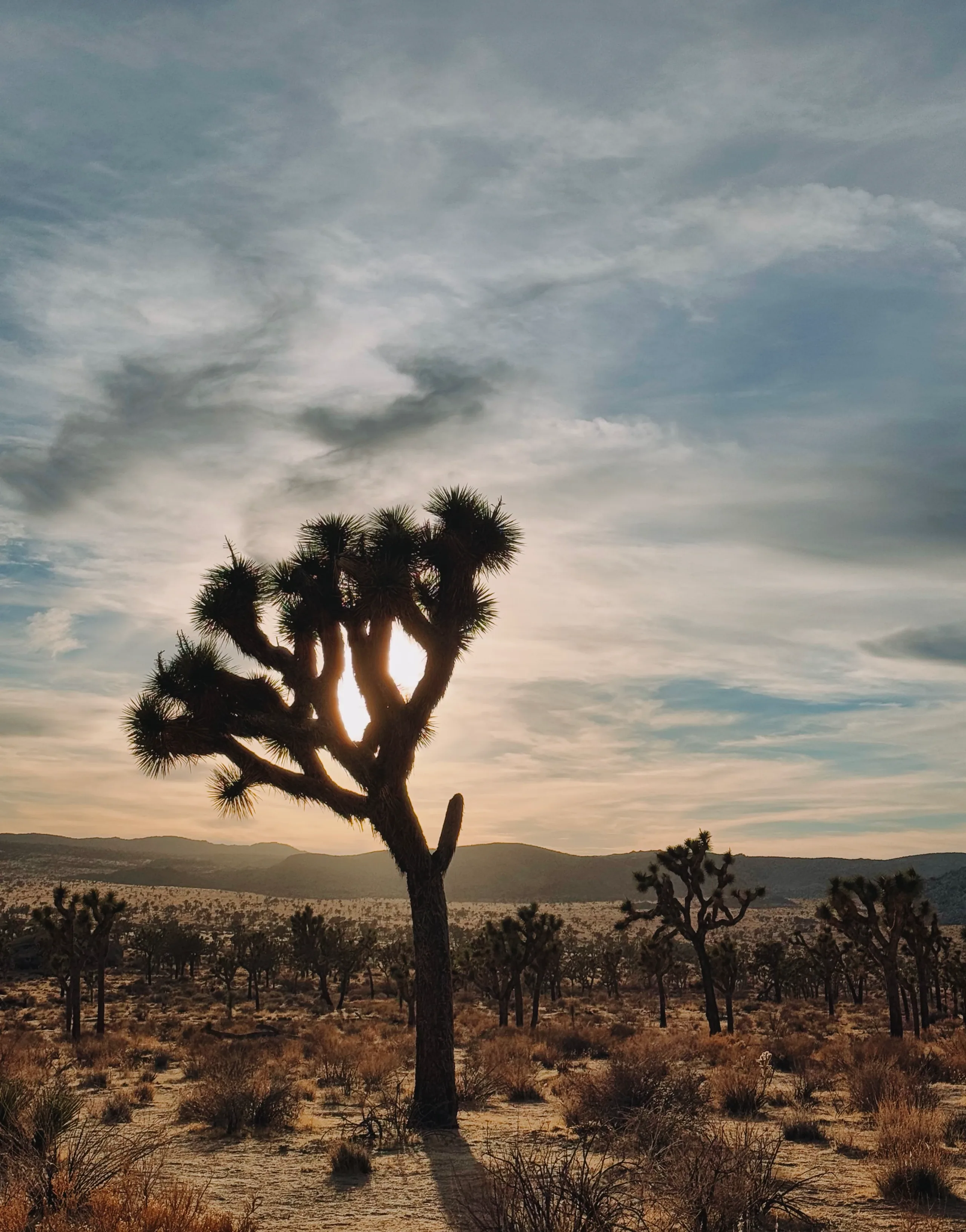
There are some places where one world melts into another. Joshua Tree National Park embodies that magic: at the transition of the Colorado and Mojave Deserts, a dreamscape where two deserts mix and reality bends just a little sideways.
With only one day to explore, we began early, entering through the south entrance. While many of the park’s highlights are closer to the northern entrances, starting from the south offers a unique experience: a gradual journey from the lower-elevation Colorado Desert into the dramatic Mojave Desert. Here, the scenery stretches all around us, all warm earth tones and wide-open space. January proves perfect for desert wandering: lightly chilly in the morning, balmy mid-day temperatures, and almost no crowds at all, even on a weekend. In most places we were alone. (The summer is not typically like this at all!)
The transition between deserts begins subtly before arriving all at once. What starts as a sparse landscape of hardy creosote bushes and spindly ocotillo suddenly transforms at Cholla Cactus Garden, where the roadside scenery erupts into endless fields of teddy bear cholla. These “jumping” cholla wait for missteps to turn into slight grazes to turn into… prickly problems. They are, as it turns out, very hard to remove.
Finally past the transition zone, the Mojave Desert now unveils its iconic residents: Joshua trees, each uniquely sculpted by wind and time. These ancient trees grow twisted and fractal-like, splitting into branches after they bloom. The result is a surreal, Dr. Seuss-like forest of gnarled giants.
Near Arch Rock, jagged granite formations rose at impossible angles and forced us to scramble through narrow passages. At Wall Street Mill, the trail led us by what felt like ghostly relics of the past, with rusting cars and decaying mill equipment sinking slowly into the sand. And as the sun dipped lower, the desert unveiled its last trick. The landscape seemed to glow from within: rocks radiated amber hues, cholla spines shimmered like fiber optics, and Joshua trees cast long, dancing shadows. In that light, the entire world turned to liquid gold.
That’s what I learned about Joshua Tree—it reveals itself layer by layer. In just one day, we watched two deserts merge, scrambled over ancient rocks, dodged vengeful cacti, and witnessed the landscape transform itself in the golden hour. I left with a few cholla spines as unplanned souvenirs and a deep sense of wonder. Joshua Tree reminds us that the most profound transitions often happen in messy, beautiful, in-between spaces.